Semax vs Selank: Different Aims, Thin Proof
Why did Moscow scientists make Semax and Selank?
Scientists at the same Moscow center aimed Semax at brain work and recovery, while they made Selank for anxiety and chose a different starting protein for each drug. Both are peptides, or short chains of seven amino acids. Russian doctors gave both through the nose.
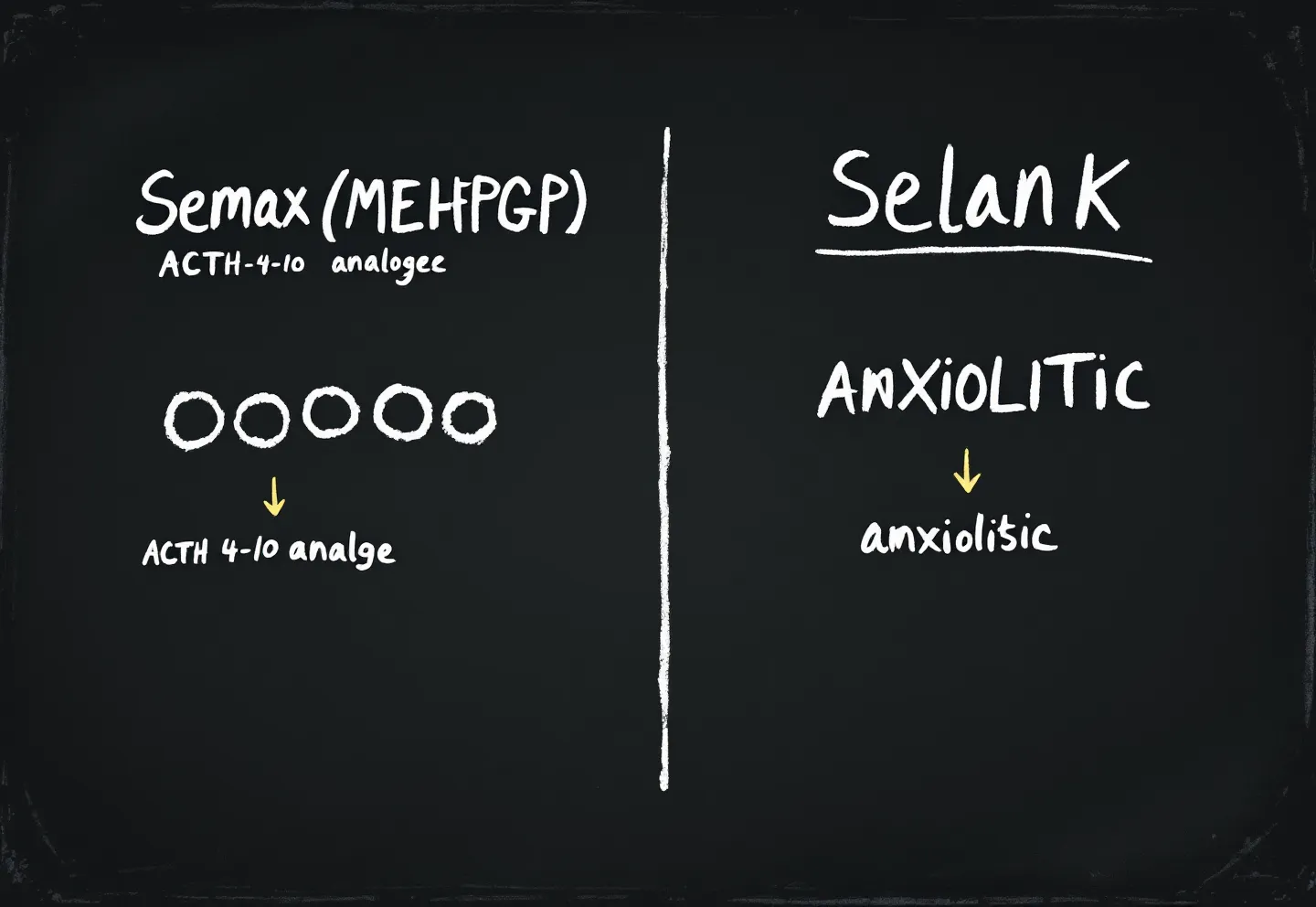
Semax starts with amino acids taken from a stress hormone. Three more amino acids help it last longer while cutting down the full hormone effect. Russian doctors used Semax for stroke recovery, thought problems, and eye nerve disease [1][7]. Selank starts with Tuftsin, a natural protein part that helps immune cells answer threats. Russian doctors mainly used Selank for anxiety.
Knowing those aims helps you judge what the later tests can answer for your care.
In Semax vs Selank, which was tested for anxiety?
Selank was made to ease anxiety. Russian trials reported less anxiety than with a placebo, or sugar pill. They also reported less sleepiness and fewer problems after stopping than some anxiety drugs. Semax was made more for thought and brain recovery.
In rats, Semax raised the use of serotonin, a chemical involved in mood. It also raised a protein that helps nerves grow [6]. Good trials haven't tested Semax as the main anxiety drug. For your anxiety question, the human work points more toward Selank.
None of these results shows that either drug fits your care.
Does Semax or Selank have more research on thought?
Semax has the more direct record on thought and memory. In rats, growth proteins rose in brain areas used for memory [3]. A different rat test found more use of chemicals involved in attention [6]. In healthy people, a test found small shifts in fast and slow brain waves after Semax nose drops [23]. It didn't show that people thought more clearly.
Selank may help focus when easing anxiety, but that would be an indirect effect. Neither set of results can promise clearer thought for you.
Semax has more work tied to thinking, yet much of that work used rats.
Did studies give Semax and Selank together?
Some Russian reports describe giving Semax and Selank together. Doctors hoped Selank might ease anxiety while Semax aided thought and recovery. The reports covered small groups and reviews of past care. They weren't strong trials that assigned treatment by chance.
Semax changed growth proteins and the use of chemicals tied to mood and movement. Selank comes from a protein that helps immune cells respond. Lab work also suggests Selank may help a brain chemical slow nerve firing. Old reports didn't describe a clear dangerous reaction between the drugs. They still can't show that the pair is helpful or safe for you.
No strong human study has compared the drugs head to head.
What proof is missing in Semax vs Selank?
Neither drug acts like a common stimulant or a sleep-making anxiety drug. Russian reports also didn't find the full stress-hormone effect with Semax. Those points kept scientists studying both drugs.
Strong human proof outside Russia is still missing. Neither drug has passed Phase 3, the large final trials that check help and harm before wide approval. The FDA has approved neither drug. Most findings still come from Russian care or rat tests. The Semax mechanism of action page explains the body changes researchers saw.
The research can help you form questions. It can't choose your care.