Semax Research: What Changed and in Whom
Semax mechanism of action: what changed in rat brains?
Researchers in Moscow designed Semax to affect the brain while muting the full force of its starting hormone. They gave male rats nose doses of 50 and 250 micrograms for each kilogram the animal weighed. A microgram is one-millionth of a gram, so the study used very small weights scaled to each rat.
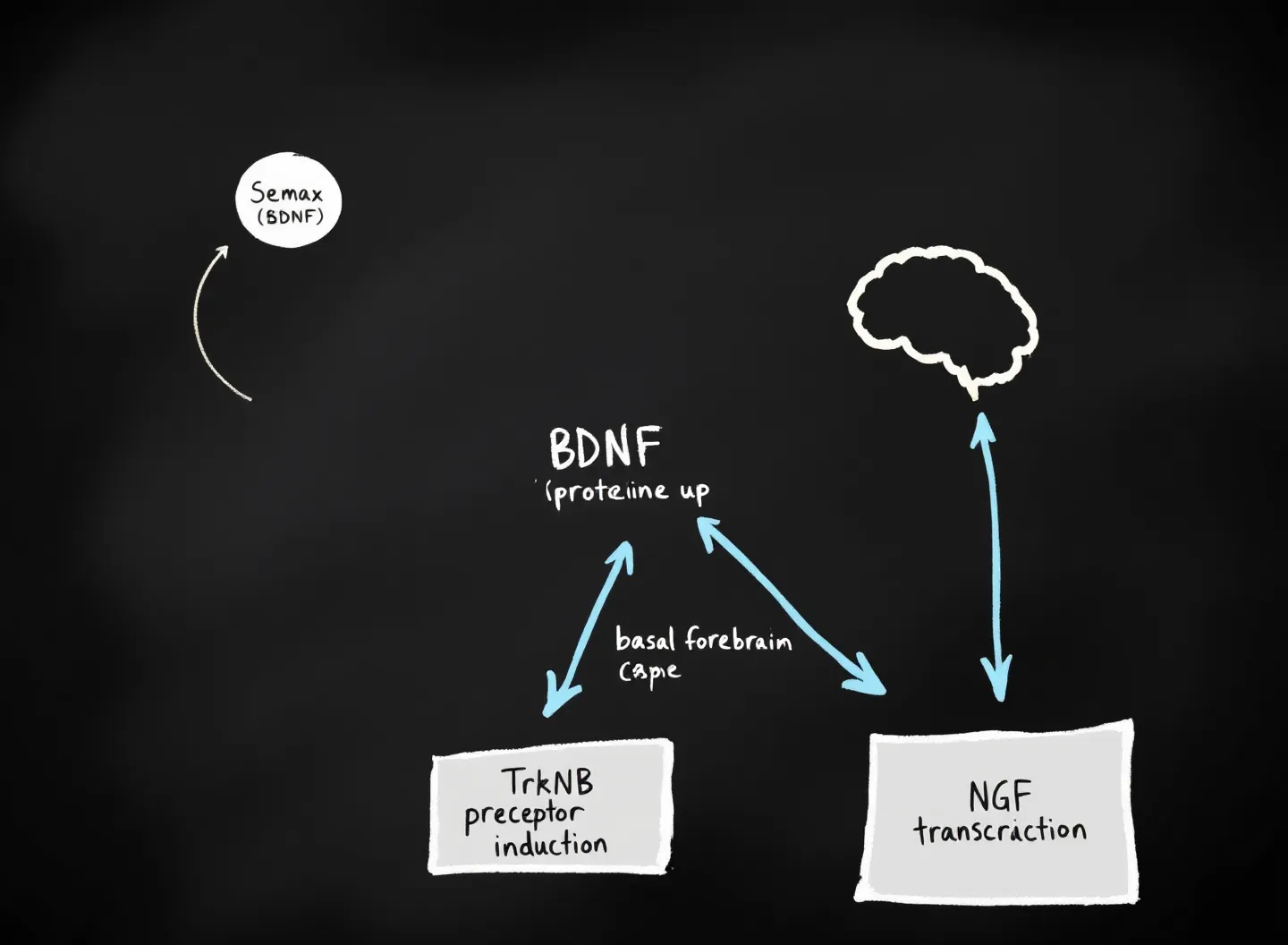
After 3 hours, one growth protein rose near the brain's base, in a part tied to attention and memory [3]. This protein helps brain cells survive and form new links. It didn't rise throughout the brain. Rat tissue can show a body change, but it can't show better memory for you.
Other rats made more of that growth protein and a second one that supports injured nerves [4]. The rise appeared in a memory area, behind the forehead, and in the light-sensing part of the eye. After a lab-made stroke, damaged cells made more of both proteins during the 3-24 hour window [10]. That could aid cell repair, but its effect on you remains unknown.
A different team gave rats belly shots of 150-600 micrograms for each kilogram they weighed. These were also tiny measured weights, but a rat amount can't tell you what amount fits a person. The rat brain breaks down serotonin after use, leaving another substance. Within 2 hours, brain tissue held about 25% more of that substance. From 1-4 hours, the fluid around brain cells held about 180% of its starting amount, or nearly twice as much [6]. The change shows that rats handled serotonin differently. It doesn't prove that your mood or thought would improve.
What else did Semax change in rats?
Semax reached rat brains within minutes after nose doses. Rats then had more growth proteins, less cell harm during poor blood flow, and more use of serotonin and dopamine [3][5][6]. Those two chemicals help brain cells manage mood and movement. The tests show changes in rats, not a benefit you could feel.
The three added amino acids also weakened the starting hormone's order to the adrenal glands. Those glands sit above the kidneys and release cortisol during stress. A weaker cortisol effect answers one concern, but it doesn't prove Semax is safe for you.
What happened in the 1997 Semax stroke study?
In 1997, 30 people got Semax nose drops soon after a stroke. Another 80 got usual care. The Semax group regained movement and other brain skills faster [7]. Patients and staff knew who got Semax, and one Russian center ran the study. That hopeful result still leaves your care uncertain.
The other tests here did not use people. Rats with too little blood reaching the brain got belly shots of 150 micrograms per kilogram. Semax held down a rise in nitric oxide, a body gas that becomes harmful to cells if it builds up [5]. In another test, rats got nose doses for six days. They had a smaller damaged brain area and remembered a learned task better [11].
Researchers also placed Semax on rat cells in dishes. The weakest mix was one-billionth strength, written as 10 to the minus 9 power. The stronger mix was one-hundred-thousandth strength, written as 10 to the minus 5 power. More cells survived the harmful chemical strain [12]. A dish result can't predict your stroke recovery. Your likely result remains unknown.
What do N-Acetyl Semax and Semax Amidate mean?
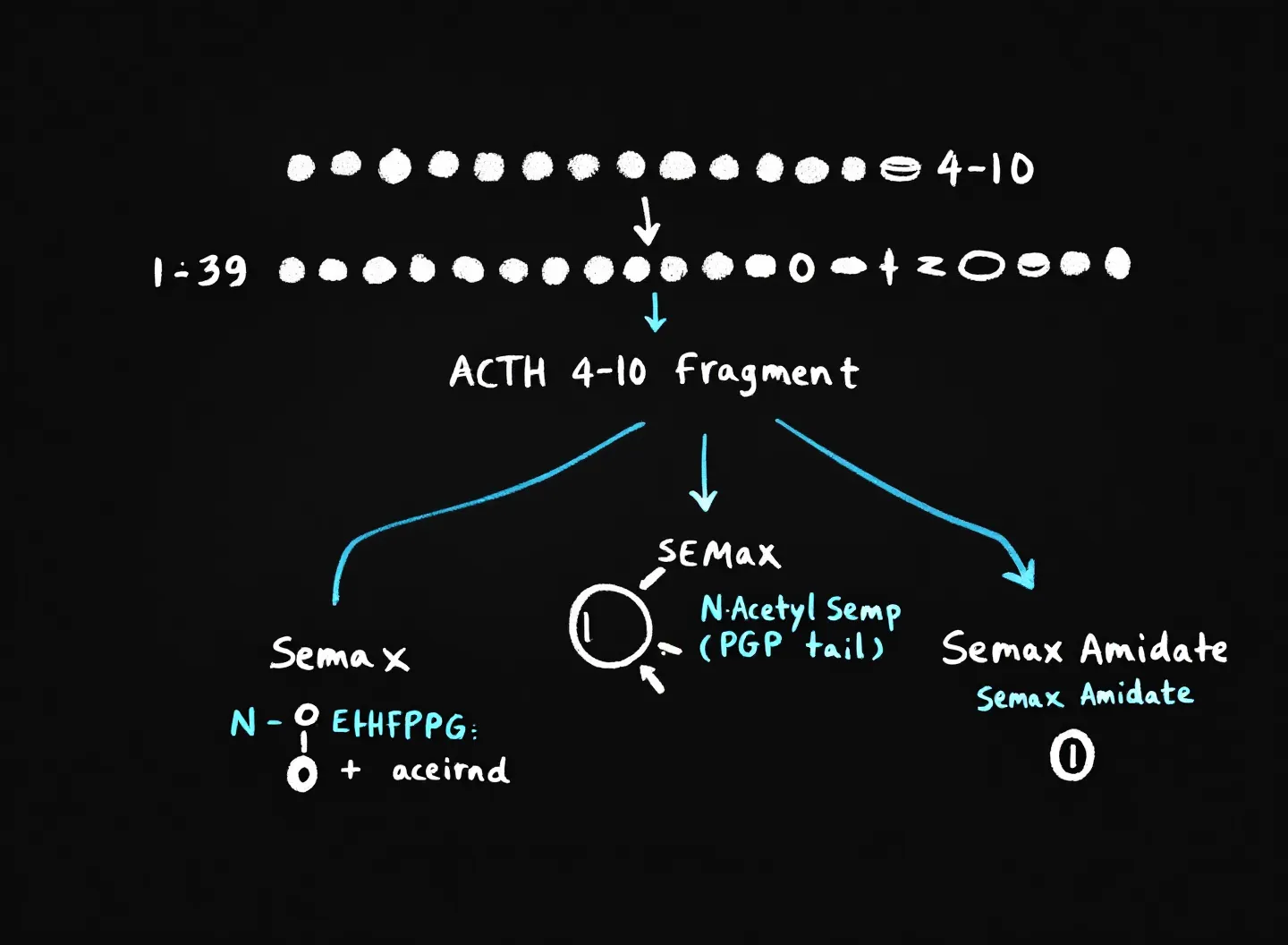
Both names describe forms that chemists changed at the ends of Semax. In N-Acetyl Semax, the N tells chemists which end was changed. They attached an acetyl group, a small cluster made from carbon, hydrogen, and oxygen. In Semax Amidate, they changed the acid group at the other end into an amide, a different chemical ending [13].
Those endings cover places where enzymes would start cutting Semax apart. Enzymes are body tools that break down food, hormones, and drugs. Lab tests found that both changed forms lasted longer than plain Semax. They aren't standard Russian medicines, and strong human trials are scarce.
Plain Semax already has three added amino acids that slow its breakdown. The extra end changes may make the other forms last still longer.
No direct human study shows that lasting longer brings you more help or less harm.
What did 2024-2025 Semax work add?
Two papers from 2025 tested new ideas about Semax. Female mice with injured spinal cords had a change in a gene tied to the body's own pain control. A gene is a set of directions inside a cell. The mice also regained more use after the injury [14]. A mouse result can't promise that you would recover.
The second 2025 paper used cells taken from rat brains. Researchers mixed 1 micromole of Semax into each liter of liquid, making a dish strength equal to one-millionth of the unit chemists use for counting tiny particles. This wasn't an amount given to a person. The cells had more brief rises in calcium [15]. Brain cells use those rises while passing messages. More rises show that the rat cells reacted; they don't prove better memory for you.
A 2020 rat study found that some genes became more active after blood returned, while others became less active [16]. The genes were tied to swelling, blood vessels, and cell death. A 2021 paper found that some proteins rose and others fell [17]. Those proteins help cells use food for energy, pass nerve messages, or hold their shape. The paper didn't show which changes helped the rats and which might have harmed them. An earlier 2014 study found more gene changes in rat brains [18].
These papers name body changes. They still don't show what Semax would do for you.
Did a Semax trial help children with attention problems?
No strong child trial gave that answer. In 2007, one paper proposed testing Semax for ADHD and Rett syndrome, a rare illness that harms a child's brain growth [19]. The idea came from rat changes in serotonin and a growth protein, not from children who improved.
The paper offered a reason to study Semax. It didn't report giving the drug to children, and no Western trial gives your family proof of help.

Does N-Acetyl Semax work better than plain Semax?
Tests in dishes found that N-Acetyl Semax and the amidate form broke down more slowly than plain Semax [13][20]. Plain Semax leaves rat blood within minutes, though cell changes may last for hours or days. The altered forms might stay longer, but that alone doesn't mean they work better.
No direct human trial shows which form helps more or carries less risk for you.