Semax reviews and the feeling of clarity
A clear head sounds like a result everyone would recognize. The accounts give that phrase several different meanings.
Personal accounts of mental clarity
Semax reviews often describe organized thoughts, sustained attention, easier word recall or more drive to finish a task. Others describe little perceptible change, tiredness or a flat feeling. These are anecdotal accounts, not clinical evidence. The people reporting them have no common test, comparison condition or agreed meaning of “clarity.”
I favor the verbal-fluency reports over broad claims of extra energy because they suggest a function that could actually be tested. The study I want here would measure word retrieval alongside participants' own impressions. At present, the appeal of the description runs ahead of the human evidence.
There is an easy confusion here with the optic-nerve paper. The eye-clinic report concerns people with optic-nerve disease. Mental clarity is a subjective description. The eye-clinic findings give no direct confirmation of the reviews about concentration.
The human EEG result
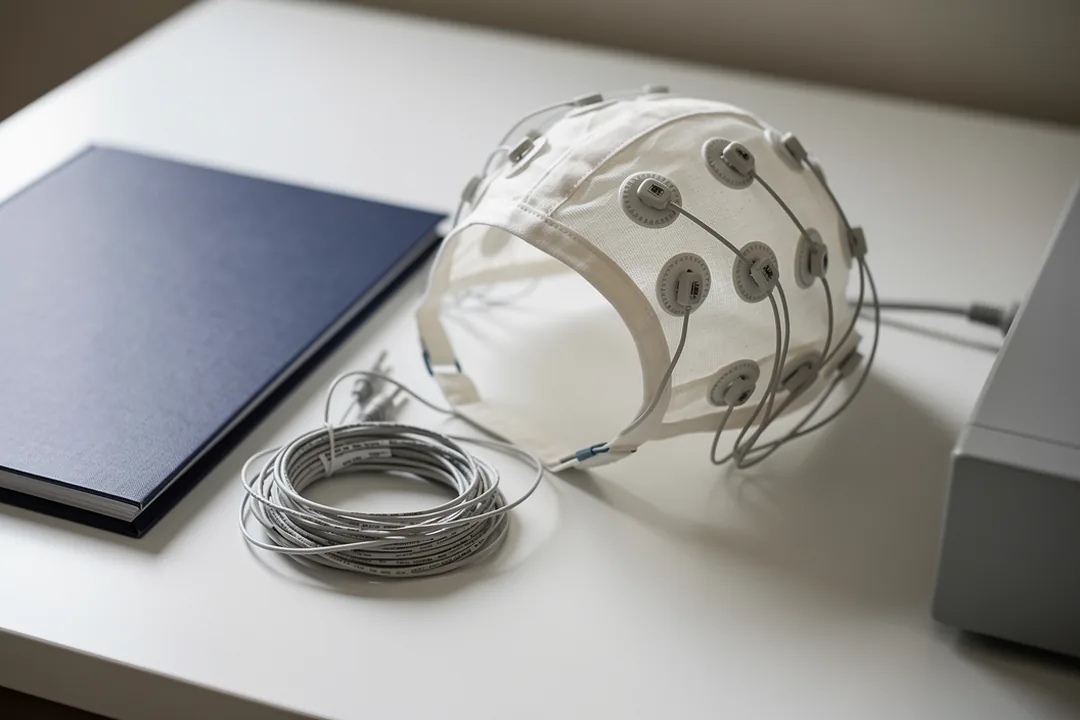
The 1996 electroencephalogram study reported changes in electrical brain activity in healthy volunteers after intranasal Semax. An EEG records patterns of that activity. The published account describes shifts in the spectrum; it establishes no improvement in memory, work performance or felt clarity.
I credit the EEG experiment for measuring an effect in humans. Its result also illustrates how much work remains between an instrument detecting a change and a person gaining a useful ability. The reviews and the EEG paper are answering different questions. Neither can complete the other's answer by resemblance alone.
Reported timing
Some accounts describe a quick change, some a gradual one, and some no useful effect. These anecdotal timing reports have no controlled confirmation. They also cannot be timed by the rat tracer experiment, which detected administered radioactivity in brain tissue at 2 minutes. That was a distribution measurement in rats.
I distrust this borrowed stopwatch: the tissue measurement cannot time a person's feeling. The dosage and half-life page follows the actual units and explains why rapid peptide breakdown and later biological effects can coexist. It offers no schedule for reproducing a reviewer's experience.
Unwanted effects and absent effects
Community accounts also mention nasal burning or congestion, headache, sleep disturbance, fatigue and irritability. Those reports are anecdotes and cannot give reliable rates or show that Semax caused each complaint. Their presence still deserves room beside the favorable stories.
The absence of a dramatic effect is especially awkward for a reputation built around mental sharpness. Some accounts call the experience subtle; others describe no benefit. I regard the reflex to explain away every disappointing account as a weakness in the case for healthy-adult enhancement. A controlled healthy-adult trial would have to count those outcomes too.
The older stroke and cerebrovascular-insufficiency reports concern clinical populations. They cannot resolve the everyday focus claims. The Semax side-effects page covers the limited safety record and the additional uncertainty around interactions.