Semax Dosage: What the Study Amounts Mean
What do the Semax dosage amounts mean?
The Moscow team made Semax for the nose, then tested amounts in rats and people that differed so much in size and method that one can't set the other for your care. A microgram is one-millionth of a gram. Rat nose tests used 50 and 250 micrograms for each kilogram the animal weighed [3]. A belly-shot test used 150 micrograms per kilogram [5]. Tests of brain chemicals used 150-600 micrograms per kilogram [6]. Tiny rat weights can't set an amount for you.
Russian stroke papers report about 6000 micrograms per day through the nose for 10 days, then a 20-day break before another course [21]. That many micrograms adds up to several milligrams. Even so, the paper can't tell how large the amount would be for your body. It describes Russian prescription care after stroke. The liquids were 0.1% or 1%, which tells how much Semax was mixed into them. The main reports were a 1997 stroke study [7] and a 2005 study of poor brain blood flow [22].
What an amount means for you depends on your illness, your body, and whether it goes through the nose or by shot.
Why did researchers use Semax nasal spray?
Russian care and rat tests mostly used Semax nasal spray. Nerves in the nose give the drug a direct path toward the brain. That mattered because rat blood broke Semax apart within minutes.
Researchers added a radioactive tag to trace where the drug went. Tagged Semax reached rat brain tissue after 2 minutes. About 80% of what they found was still whole Semax [20]. The rest had broken into shorter parts.
For you, this only shows where a rat dose went. It didn't show help that a person could feel.
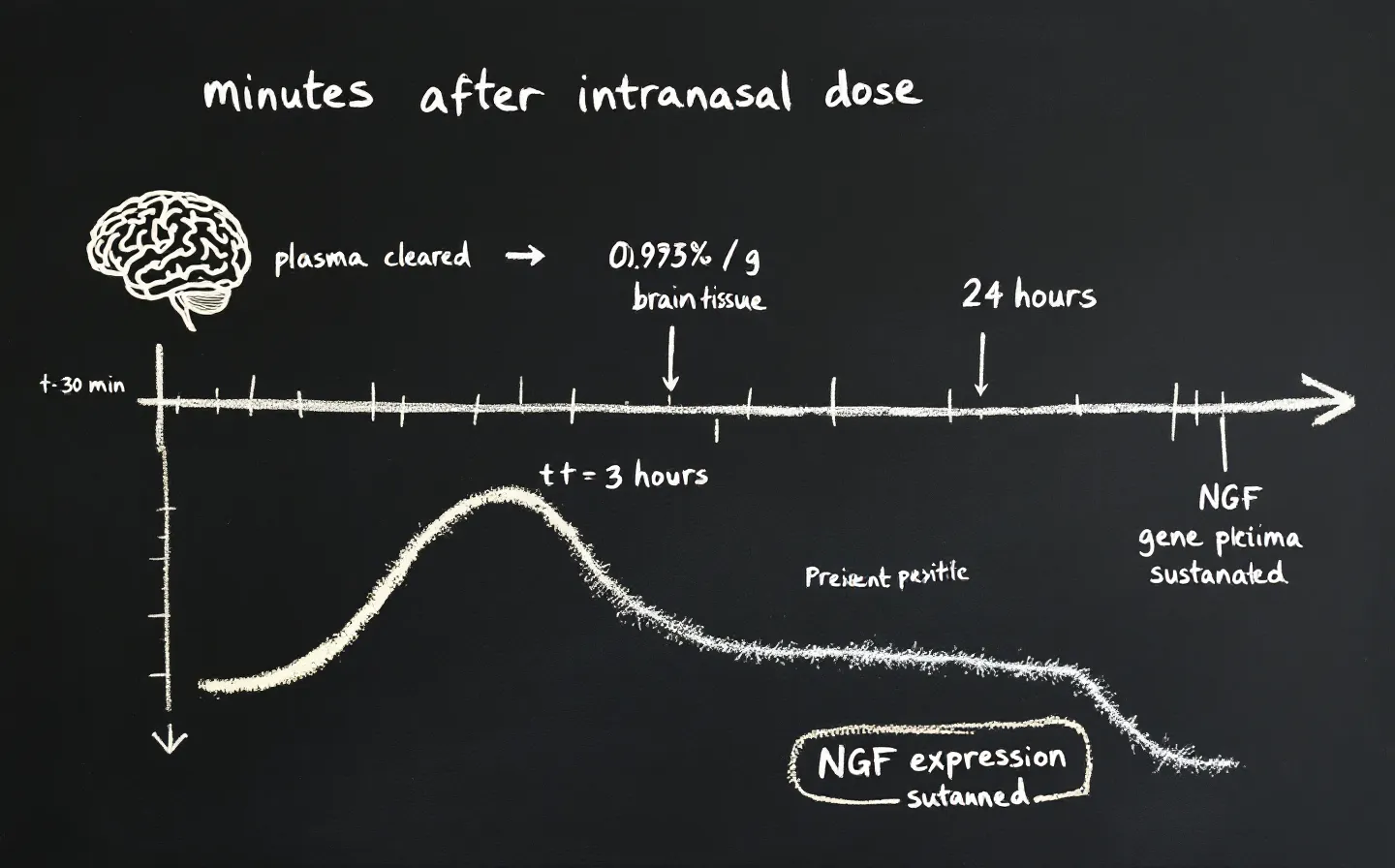
Semax half-life: how fast did rat blood clear it?
Semax half-life means the time needed for half the drug to leave the blood. In rats, that took only minutes [20]. Soon after a dose, body samples held more broken pieces than whole Semax. Rats broke the drug apart fast.
Other rat tests found that growth proteins stayed changed for hours or days [3][4]. A human brain-wave test also found a short-lived change [23]. Cells can keep making proteins after Semax has left the blood.
A brief stay in rat blood can't tell you what you might feel or how long it might last.
What did early brain tests after Semax show?
Rat tests found Semax in the brain within minutes after a nose dose [20]. Russian papers say researchers checked people's thinking 20-60 minutes later. The short reports don't name the tasks or say what useful skill changed.
In healthy adults, a test of electrical activity found small shifts between faster and slower brain waves [23]. The paper didn't tie those shifts to better memory, clearer thought, or any change a person noticed.
How long did rat changes last after Semax?
Whole Semax left rat blood in under an hour [20]. Yet brain cells kept making more growth protein for hours or days [3][10]. The drug can leave the blood before the cell work ends.
In another test, rats got nose doses for six days after a lab-made stroke. They had a smaller damaged area and kept a learned task better [11]. That doesn't tell you how long a person might feel any change.
How long did human Semax studies last?
Russian reports ran from one stroke treatment to 10-day courses and longer care for poor brain blood flow [7][22]. They give little safety news past the 10-day stroke period.
A 2005 study watched people for six months. Flare-ups from poor brain blood flow became less common [22]. The short report didn't say by how much. It found no major safety problem, but everyone knew who got Semax. The group was also too small to catch every rare harm you might face.
Safety over months or years remains unknown for you.
How much Semax was in the nose liquids?
Labs mixed dry Semax with sterile water or salt water. Russian medicines came as 0.1% liquid, with 1 milligram in each milliliter. They also came as 1% liquid, with 10 milligrams in each milliliter. A milliliter is a small measured amount of liquid. A set nose sprayer gave the amount used in the study [21].
These figures describe mixes made in trained labs and Russian clinics. They can't give you a home mixing plan or a personal amount.
What did researchers mix with dry Semax?
Researchers added sterile water, meaning water free of germs, to dry Semax. They chose the liquid strength needed for each test. Three amino acids at one end help protect Semax from enzymes. Those body tools cut apart food, hormones, and drugs.
Mixed Semax can still break down. Study teams kept it cold and used it within the time set for that test. Their work can't tell you how long an unknown product stays safe.
Could rat Semax amounts become a human dose?
No. Most human papers gave Semax through the nose. They listed 250-1500 micrograms for one dose and daily totals near 6000 micrograms in the stroke paper [21]. A microgram is one-millionth of a gram, so these are small weights. The figures still record Russian care and can't set a dose for you.
Rat papers listed belly shots of 150-600 micrograms per kilogram. A rat shot can't be turned into your nose amount. Your body, a rat, a shot, and a nose spray each handle the drug differently.